Korean scalp treatment in Seoul: exosome, stem cell or PRP, and trips
What a Korean scalp treatment really involves, how exosome, stem cell and PRP claims compare, and how to plan sessions around trips to Seoul.
What is a Korean scalp treatment, and why fly to Seoul for one?
If your part is widening or your hair feels finer than it used to, a Korean scalp treatment probably came up in your search, often labelled as exosome, stem cell or PRP. Those words mean different things, and the difference matters when you're booking flights around them.
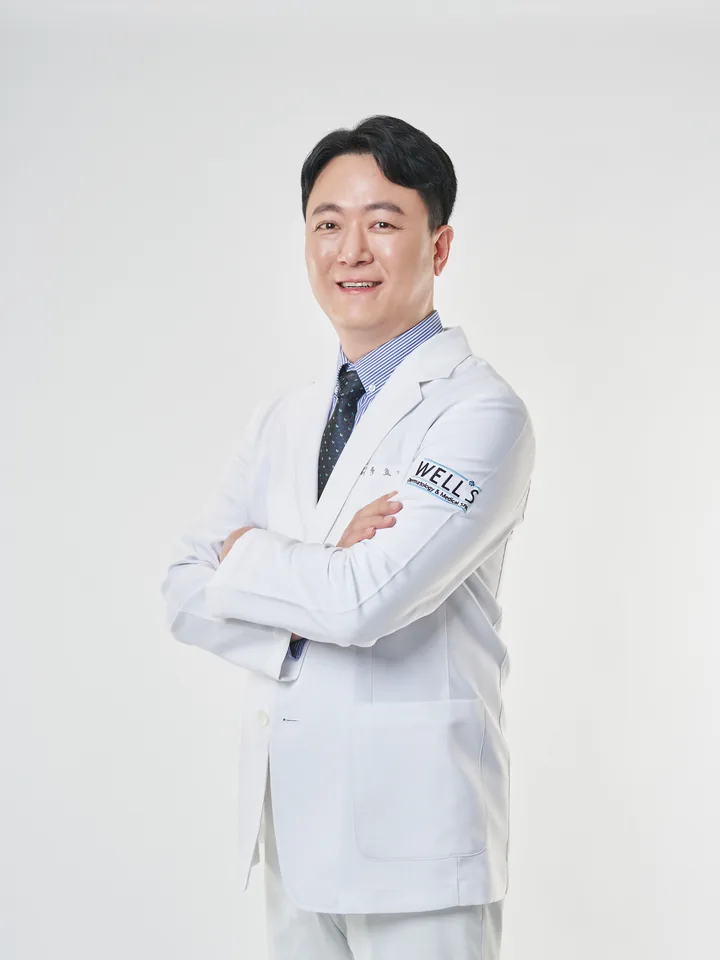
I'm Dr. Hyo Seop Ryu, a chief director at WELLS in Apgujeong. I'm an M.D., Ph.D. and board-certified dermatologist, and I was a clinical instructor and assistant professor at Seoul National University Bundang Hospital.
At a Seoul dermatology clinic, scalp treatment is medical: a doctor diagnoses the cause first, then delivers active ingredients into the scalp. At WELLS we treat thinning hair as ageing of the follicle, not only as genetic hair loss, and our main program uses CeraXosome, an exosome developed by our own dermatologist, Dr. Won Woo Choi.
What a session involves and what it costs is covered in our scalp treatment guide. This post answers the questions that come up when you're travelling for it.
Stem cell scalp treatment in Seoul: what is and isn't in the vial
The phrase stem cell scalp treatment Seoul shows up in a lot of advertising. It's worth asking what is actually injected, because products marketed this way are generally derived from stem-cell culture media, not living stem cells.
CeraXosome is different in origin. It's made by precisely fermenting Sphingomonas, a beneficial microbe found on a healthy scalp, then purifying only the extracellular vesicles it releases. It is plant-derived and research-based, not a stem-cell culture product, and it's suitable for men and women.
So if you're looking for a Korean stem cell scalp treatment specifically, I'd be honest: we don't inject stem cells. What our hair loss program aims to do is supply signalling molecules and nutrients so the stem cells that build your own hair root can regenerate.
| Study | Measure | Result |
|---|---|---|
| Dermal papilla cells | IGF-1 and VEGF expression | Dose-dependent increase |
| Signalling | Wnt/β-catenin via AKT/GSK3β | Activated |
| Ex vivo human follicles | Hair-shaft growth rate | About +40% over 6 days |
| Ex vivo human follicles | Hair thickness | About +30% |
Those figures come from follicles studied in the lab, not from patients' scalps, so read them as mechanism, not a promise. The work was published in Experimental Dermatology and presented at the World Congress for Hair Research 2026.
Scalp PRP in Seoul: do we offer it?
Scalp PRP in Seoul is a common search, so here's a straight answer: PRP isn't part of our treatment list at WELLS. I'd rather tell you that now than have you find out at the front desk.
What we use instead depends on the cause and stage of your hair loss. The options are CeraXosome infiltration, growth-factor infiltration, EMTS (electrical microneedle stimulation) and prescription medication where appropriate.
For women especially, drug suitability depends on pregnancy potential, hormonal status and the type of hair loss. That's a consultation decision, not something to decide from an online list.
How many Korean scalp treatment sessions, and how to plan them around flights
This is the part most travellers underestimate. Scalp treatment works as a series, and CeraXosome infiltration is typically repeated every two weeks, usually 5 to 10 times. After that, monthly maintenance sessions can be considered.
The listed CeraXosome Scalp & Hair Program is ₩770,000 (VAT excluded). It includes a scalp microbiome test, one in-clinic session and three boxes of NMN chewable supplements for three months of home care. The dermatologist advises how many sessions fit your case.
Realistic ways to fit it into travel
- A longer stay in Seoul: two-week intervals fit well if you're here for a month or more.
- Short, repeated trips: we start with the microbiome test and a session, and the chews continue at home between visits.
- One trip only: you still get a diagnosis, baseline photos and a plan you can take home, which is worth having before you commit to anything.
Results vary from person to person. Some people notice a change in hair condition after one to two months, and it's far easier to work with thinning hair while follicles can still respond than after hair is gone.
Tell us how long you're staying in Seoul and send a photo of your crown and hairline. We'll suggest a session plan that fits your dates.
Plan scalp sessions on WhatsAppWhat happens on the day, and can you fly afterwards?
Before the first session we take standardized photographs of your hairline and crown and run the scalp microbiome test. That baseline is what we compare against later.
- Numbing: lidocaine spray on the hairline, and the crown if treated, left for about three minutes.
- Delivery: CeraXosome goes into the scalp with a fine microneedle system, kept at a needle depth of 0.25mm or less.
- Also in the session: an AQ injection and electromagnetic therapy.
There's no incision or transplant, and you return to daily life right after the short visit. If you have a flight soon after, tell us the time on WhatsApp and the dermatologist will advise on timing.
Why the microbiome test comes first
Looking at the scalp in a mirror tells you how much hair you've lost, not how many follicles are weakened and close to shedding. The microbiome test measures how far scalp ageing and hair loss have progressed, including changes you can't see yet.
We then set the number of sessions and the direction of treatment from those results, one patient at a time. For a traveller, that matters: it tells you before you book return trips whether a series is worth it, or whether another route makes more sense.
Who a Korean scalp treatment suits, and who needs something else
The program is designed for thinning at the hairline or crown, fine, weak hair losing volume, postpartum or postmenopausal shedding, and care after a hair transplant.
In women, thinning usually shows as lower density around the crown and part line rather than a receding hairline. It often begins after midlife and is easy to dismiss as just age, which is exactly when a diagnosis helps most.
If hair loss has already progressed very far, a transplant may be the better route, and I'll say so. In the early stage of scalp ageing, surgery usually isn't needed. And diet and lifestyle alone won't stop hair loss that is already under way, though sleep, exercise and less alcohol and smoking still support treatment.
How the visit works at WELLS
Message us on WhatsApp with your concern, a photo if you like, and your travel dates. We reply in English with options and appointment times. At the clinic a dermatologist examines your scalp, confirms the plan and the price, and treatment takes place in the same clinic.
We're on the 8th floor of the Apgujeong Building, five minutes from Apgujeong Station Exit 3 on Line 3, open Monday to Friday 10:00–20:00 and Saturday 10:00–17:00. Directions are on our clinic page, and you can read about the whole team on our doctors page.
Not sure whether your thinning is hair ageing, shedding or something else? Send photos and your dates, and a dermatologist will tell you what's worth doing on this trip.
Ask a dermatologistGet a scalp plan that fits your trip
Send photos of your crown and hairline with your travel dates. A dermatologist replies in English with a suggested plan, and the final price is confirmed at consultation.
Message the clinic on WhatsAppReplies on WhatsApp · prices in KRW, excluding 10% VATBefore you message us
Is CeraXosome a stem cell scalp treatment?
No. CeraXosome is an exosome made by fermenting the scalp microbe Sphingomonas. It is plant-derived and research-based, not a stem-cell culture product.
Do you offer scalp PRP in Seoul?
PRP isn't on our treatment list. We use CeraXosome, growth-factor infiltration, EMTS and prescription medication depending on the cause and stage of hair loss.
How much is the CeraXosome program?
₩770,000 (VAT excluded), including a scalp microbiome test, one in-clinic session and three boxes of NMN chewable supplements.
How often are sessions done?
Infiltration is typically repeated every two weeks, usually 5 to 10 times, with monthly maintenance afterwards if needed. The dermatologist advises what fits your case.
Is the consultation in English?
Yes. Consultations are available in English, and WhatsApp replies are in English.
Results and recovery vary by individual. Every treatment carries possible side effects, which are explained at the consultation. Prices are in Korean won, excluding 10% VAT, and confirmed at your consultation. This article is general information from the clinic, not a diagnosis.
Dr. Hyo Seop Ryu
- Board-certified dermatologist, M.D., Ph.D.
- Clinical instructor, Department of Dermatology, Seoul National University Bundang Hospital
- Assistant professor, Seoul National University Bundang Hospital
- Visiting professor, Dubai Maris Clinic, through International St. Mary's Hospital
- Former chief director, Bundang Bon Dermatology Clinic