How safe is pico laser tattoo removal? Rarely scarring, if you know when to wait
In a dermatologist's hands, pico laser tattoo removal is low-risk: redness, blisters and temporary light or dark patches are common, scarring is uncommon, and a tan, raised-scar history or pregnancy are reasons to wait.

Whether this treatment suits you needs a dermatologist to assess. Send a photo and your travel dates on WhatsApp, and we reply in English whether it can be arranged for your case and which days are open.
Ask us on WhatsApp
What a pico laser actually does to ink and to the skin around it
How safe is pico laser tattoo removal for skin like yours, if a cut once healed as a thick raised scar, or an earlier laser session somewhere else left the tattoo blistered and patchy?
For healthy skin treated by a dermatologist, it is a low-risk treatment. Redness, swelling, pinpoint bleeding and some blistering are expected for days, light or dark patches usually fade within 6 to 12 months, and scarring is uncommon. The risk climbs with a tan, a history of raised scars, pregnancy, and energy pushed too high to finish faster.
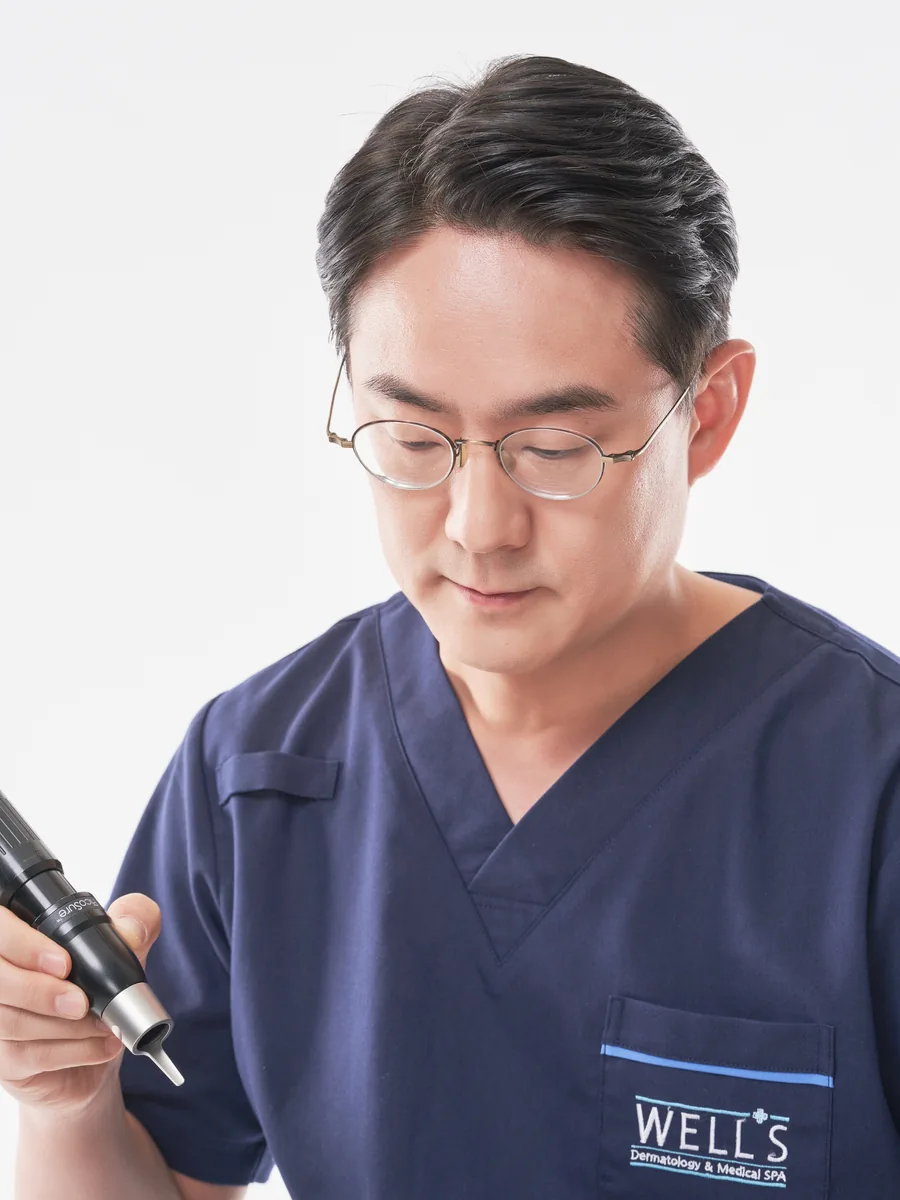
Hello, I'm Dr. Won Woo Choi, Medical Director (M.D., Ph.D.) at WELLS Clinic in Apgujeong, Seoul.
I'm a board-certified dermatologist trained at Seoul National University Hospital, and at WELLS a board-certified dermatologist handles your consultation, diagnosis and treatment, so the person weighing your scar history is the person treating you. Our dermatologists have over fourteen years of tattoo-removal experience and assess the ink and the skin before deciding the method. If language is part of the worry, a medical interpreter for your language is provided at no extra charge.
If your skin has a history that worries you, send one daylight photo of the tattoo on WhatsApp with a line about any raised scars or earlier removal attempts, and ask whether that history changes how you'd be treated.
Send a clear photo and your travel dates, and we will tell you what fits the time you have in Seoul.
Send a photo of your tattoo and your scar history on WhatsAppA picosecond laser fires pulses measured in trillionths of a second. Ink particles are hit so briefly that they shatter mostly from the pressure wave, and your immune system carries the fragments away over the following weeks. Picosecond pulses are about 1,000 times shorter than older Q-switched lasers, so ink breaks into finer pieces while less energy reaches the surrounding skin.
Think of breaking an ice cube with one sharp tap of a spoon instead of setting the whole tray on a warm stove. The tap cracks the cube; the stove warms everything around it. That difference in heat is where most of the safety comes from.
It is also where the limit sits. Your own skin pigment absorbs some of the same light the ink does, which is why skin tone and recent sun matter so much for safety. The darker or more tanned the skin, the more energy is shared with cells you want to leave alone.
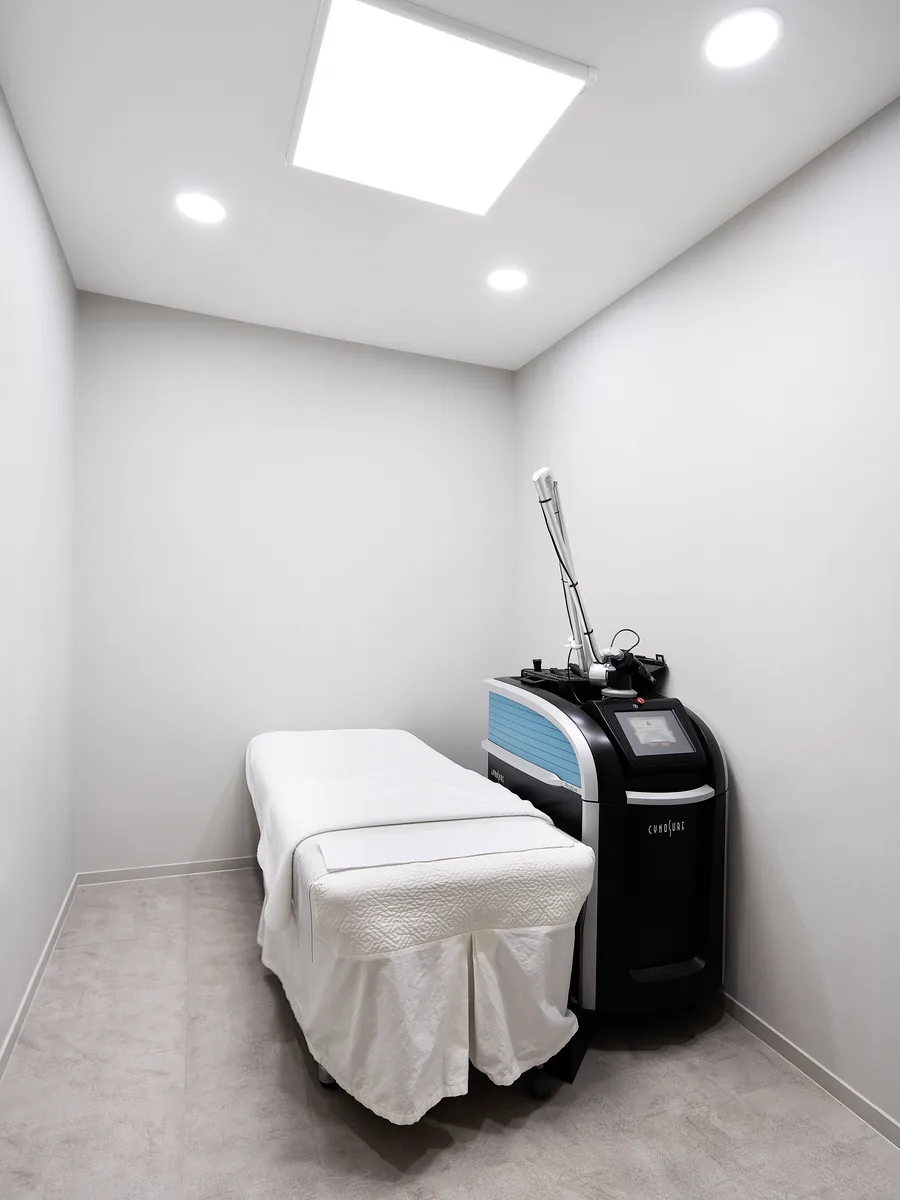
Color matters too. Black ink absorbs a wide range of wavelengths, red responds to 532 nm, and blue and green respond to longer wavelengths such as 755 nm. We use PicoSure Pro at 755 nm together with 532 nm and 1064 nm for this reason. A device with a single wavelength can leave some colors behind, and repeated passes to chase a stubborn color are a common way skin ends up overtreated.
Worried about your own case? Let a dermatologist look first: send a photo and your dates, and we reply whether it can be arranged.
Ask us on WhatsAppThe first two weeks: what's normal after a session
Most of what happens in the first fortnight looks dramatic and is expected. This is the rough sequence for a typical black tattoo on healthy skin.
| When | What you'll usually see |
|---|---|
| Minutes after | White "frosting" over the ink, fading within about half an hour |
| Days 1–3 | Redness, swelling, pinpoint bleeding, tenderness like a sunburn |
| Days 2–7 | Blisters or crusting, more over dense ink |
| Weeks 1–2 | Flaking and itching as the surface closes |
| Weeks to months | Lighter or darker patches that usually fade within 6–12 months |
Infection and scarring: what to watch for
Aftercare advice from the American Academy of Dermatology is short and worth following exactly: wash the area, apply ointment for a few days as your dermatologist instructs, moisturize and keep it covered until healed, then protect the treated skin from the sun for 3 months with clothing that fully blocks light. Leave blisters intact. A popped blister is an open wound, and open wounds are where infection and scarring start.
Scarring, light or dark patches, and ink that turns darker
Scarring after pico laser is uncommon when a dermatologist sets the energy and the spacing. When it happens, the usual causes are energy set too high, sessions packed too close together, a blister picked open or an infection. Work done by non-specialists sometimes leaves marks that take longer to settle, so if your tattoo already went through a rough attempt, the skin's condition now matters more than the ink.
Pigment change is the side effect people meet most often. The laser's inflammation can leave darker patches (post-inflammatory hyperpigmentation), which show up more readily in olive and brown skin, or lighter patches, which tend to appear after many sessions on the same spot. Both usually fade over months, though in some skin they take longer.
Cosmetic tattoos carry a risk that body tattoos rarely do. White, flesh-toned and some red or brown inks contain iron oxide or titanium dioxide, and a laser pulse can turn them dark gray or black instantly. That is why a small test area is a sensible first step for brows, lip liner or concealer-type ink, and it's covered in more detail in our post on fading old eyebrow tattoos with pico lasers.
Allergic reactions are rare but real. Some people react to red ink in particular, and breaking that ink up can occasionally set off itching or a rash. If a red part of your tattoo has ever been raised, itchy or swollen, say so before treatment. Healing speed and pigment response differ from one person to the next, which is why the plan is set for your skin rather than from a chart.
Risks and side effects to know
Say you're 31, with olive skin, a black-and-red forearm piece and a raised scar on your knee from a childhood fall. That scar doesn't rule you out. It tells me your skin tends to over-repair, so I would start with lower energy, space sessions further apart, treat the red area cautiously, and watch how the first session heals before going further.
When should you wait, or not do it at all?
Some situations mean postponing, a few mean not treating. Wait until a tan has fully faded before any session; tanned skin absorbs more energy, and that raises the risk of burns and pigment change.
- Pregnancy or breastfeeding: no treatment until you've finished.
- A tan, a recent beach trip or self-tanner on the area.
- Keloids or raised scars on or near the tattoo: a slower plan at the very least, and a keloid on the tattoo itself is often a reason not to treat.
- Isotretinoin taken for acne in recent months: many dermatologists prefer to wait, because healing can be slower.
- An infection, rash, eczema flare or open wound over the tattoo.
- A weakened immune system or a condition that affects healing, since clearing the ink depends on it.
- Recent self-treatment with removal creams, salt or acid: the skin needs to settle first.
If one of these points applies to you, put it in a WhatsApp message together with a list of the medicines you take, including anything for acne, and ask whether it means waiting and how long you'd be waiting.
Send a clear photo and your travel dates, and we will tell you what fits the time you have in Seoul.
Send a photo of your tattoo and your scar history on WhatsAppWhy more energy per session is not the safer shortcut
In short, it's tempting to think a stronger session means fewer trips. Layered ink can't be safely broken down in one visit; the skin needs to heal and the immune system needs time to clear fragments before the next pulse. Sessions are commonly spaced six to eight weeks apart or more, and fading changes with the ink's color, density and depth.
Picosecond pulses do usually mean fewer sessions overall than older lasers, because the ink breaks up more finely. The shortcut that causes harm is going higher on energy or closer on spacing than the skin can handle. If you want to see how the tattoo and the plan change from one visit to the next, our post on what changes at each PicoSure session walks through it.
Planning sessions around flights, sun and other lasers
A fresh session and a long-haul flight can go together if the area stays clean and covered. Pack non-stick dressings and ointment in your carry-on, wear loose clothing over the area, and leave at least a day in Seoul after treatment instead of flying out the same evening. The clinic is closed on Sundays and public holidays, so a Saturday session leaves no weekday follow-up before a Sunday flight.
Sun is the bigger travel problem. A session followed by a beach week is the setup for dark patches. Book removal at the end of a trip, not the start, and keep the area covered for the 3 months afterward.
Here is a mistake almost nobody warns you about: hair-removal lasers are absorbed strongly by tattoo ink and can burn it. If you're also considering laser hair removal in Korea for men, tell the doctor where your tattoos sit so those areas are avoided. For how the full course fits several trips, see PicoSure sessions and planning a tattoo-removal trip to Korea.
Once you're home, spreading redness, warmth, pus, fever or a blister that keeps growing need a local doctor within a day or two. Keep photos of the area from each day and ask for a written note of the wavelengths used, so a doctor at home sees what was done.
What to ask any clinic before the first pulse
Wherever you have it done, these questions sort out most of the risk before you're in the chair:
- Who examines your skin, and is that same doctor the one treating it?
- Which wavelengths are available for each color in your tattoo?
- If you scar or pigment easily, how would the energy and spacing change, and would they test a small area first?
- What aftercare do you take home, and who do you contact after you fly back?
- Is a medical interpreter present for the consultation, so you understand the risks in your own language?
It doesn't have to be us. Wherever you go, clear answers to these tell you more about your safety than the device name on the website.
So how safe is pico laser tattoo removal for someone with a difficult history? In my view it's a reasonable treatment for most tattoos, and the risk I take most seriously is impatience. Scar history, skin tone and recent sun don't usually rule you out; they change the pace. There is no reason to rush this decision.
When you're ready, send your travel dates on WhatsApp with the photo of the tattoo, and ask whether those dates leave enough healing time before your flight home. We're at 8F Apgujeong B/D, 842 Nonhyeon-ro, Gangnam-gu, five minutes' walk from Apgujeong Station Exit 3, and in Seoul what shapes your plan is how deep and dense the ink sits and how your skin has healed before.
— Dr. Won Woo Choi, Medical Director
Plan your visit before you fly
Send a daylight photo, your travel dates and what you have tried before. A dermatologist will suggest where to start and what fits your stay.
Send a photo of your tattoo and your scar history on WhatsAppReplies on WhatsApp · prices in KRW, including 10% VATBefore you message us
How safe is pico laser tattoo removal on darker skin?
It can be done, but olive and brown skin is more prone to temporary dark or light patches because skin pigment absorbs part of the laser energy. Lower energy, wider spacing between sessions, strict sun protection and a small test area first make it safer.
Can a pico laser remove a tattoo in one session?
Rarely. Layered ink can't be safely broken down in one visit, and the body needs weeks to clear the fragments. Most tattoos need several sessions spaced weeks apart.
Where does the broken-up ink go?
The fragments are picked up by immune cells and carried away through the lymphatic system over weeks. Long-term research on this is limited, which is one more reason not to overtreat in a single session.
Does it hurt, and can the area be numbed?
Most people compare each pulse to a rubber band snapping on the skin, and the session itself is short. A numbing cream or a local anesthetic injection can be used to reduce discomfort.
Can I swim or exercise after a session?
Avoid pools, the sea and hot tubs until the skin has fully closed, which usually takes one to two weeks. Light exercise is fine, but keep sweat and friction off blisters.
Results and recovery vary by individual. Every treatment carries possible side effects, which are explained at the consultation. Prices are in Korean won, including 10% VAT, and confirmed at your consultation. This article is general information from the clinic, not a diagnosis.
See the treatment in detail, or ask us
You can ask whether it suits your case, which dates are open, and about language support.
Message us on WhatsAppDr. Won Woo Choi
- Board-certified dermatologist in Korea; trained at Seoul National University Hospital
- Dermatology residency, Seoul National University Hospital; board certification in dermatology in Korea
- Ph.D. in Dermatology, Seoul National University
- Former clinical instructor, Seoul National University Hospital
- Adjunct professor, Department of Dermatology, Seoul National University Hospital
Medically reviewed by Dr. Won Woo Choi
Full profile