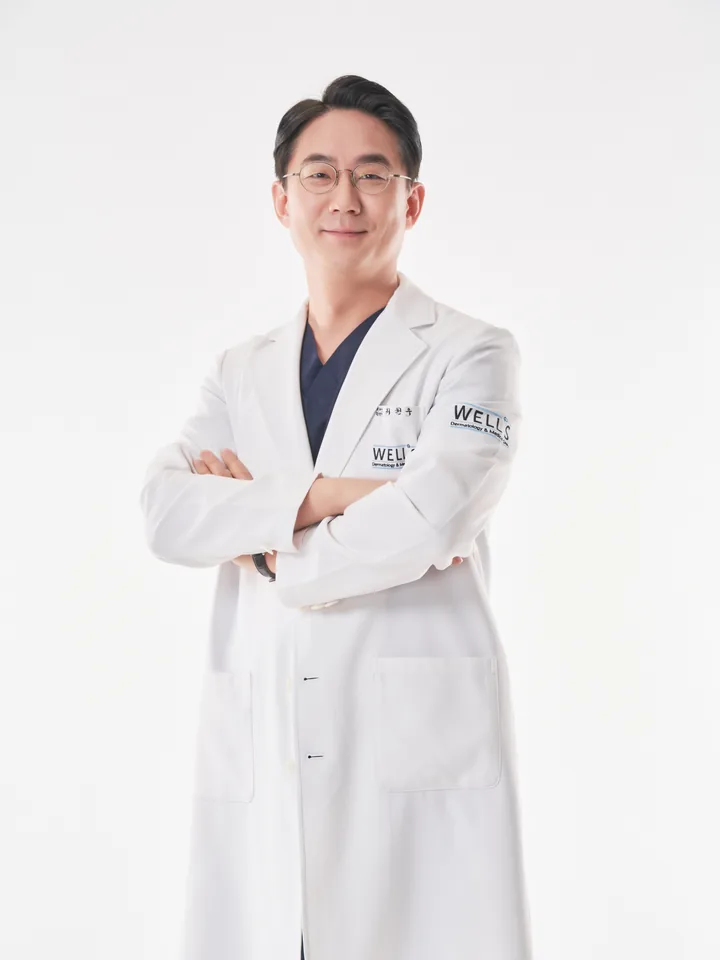
Dr. Won Woo Choi
Dr. Won Woo Choi is a board-certified dermatologist trained at Seoul National University Hospital, and he co-founded WELLS Dermatology in Seoul in 2008. He holds a Ph.D. in dermatology from Seoul National University and is CEO of CutisBio, the company that developed CeraXosome.
Dr. Won Woo Choi최원우
Signature focusHair and scalp aging, pigmentation and lifting. Developed CeraXosome at CutisBio.
- Ph.D.Ph.D. in Dermatology, Seoul National University
- Board-certifiedBoard-certified dermatologist (Korea), trained at Seoul National University Hospital
- CutisBioCEO, CutisBio Co., Ltd. — developer of CeraXosome
Education, training & memberships
Education
- Master's coursework in medicine completed, Seoul National University
- Ph.D. in Dermatology, Seoul National University
Training
- Dermatology residency, Seoul National University Hospital; board certification in dermatology in Korea
Board certification
- Board-certified dermatologist in Korea; trained at Seoul National University Hospital
Positions
- 2008Co-founder of WELLS Dermatology (2008)
- Former clinical instructor, Seoul National University Hospital
- Adjunct professor, Department of Dermatology, Seoul National University Hospital
- CEO, CutisBio Co., Ltd.
Memberships
- Member, Korean Dermatological Association
- Member, Korean Association of Dermatologists
- Member, Korean laser society
- Member, Korean aesthetic dermatology society
- Member, Korean cosmetic dermatology society
- Member, Korean Society for Hair Research
- Member, Korean society for obesity and body-contouring medicine
- Member, Korean atopic dermatitis society
- Member, American Academy of Dermatology (AAD)
- Member, American Society for Laser Medicine and Surgery (ASLMS)
What Dr. Choi performs most
- Hair
CeraXosome Scalp & Hair Program
CeraXosome was developed by Dr. Choi at CutisBio; he presented the program at the World Congress for Hair Research 2026.
See treatment - Pigmentation & Melasma
Melasma & Stubborn Pigment (Pico Toning)
Dr. Choi presented a five-session analysis of combined pico laser melasma treatment at the Korean Dermatological Association meeting.
See treatment - Skin Tightening & Rejuvenation
Thermage MAX
Dr. Choi chaired a Korea–Japan dermatology meeting on Thermage and skin-aging treatment in January 2026.
See treatment - Skin Tightening & Rejuvenation
Sculptra Lifting
Dr. Choi chaired and lectured at a Galderma meeting for dermatologists on facial lifting with Sculptra (July 2026).
See treatment
Conferences, lectures & panels
- Session chair
Korea–Japan dermatology meeting on Thermage and skin-aging treatment
- KRLecture
Spring meeting of a Korean aesthetic dermatology society — reducing neuromodulator resistance and side effects
- CNInvited lecture
APEC, Shanghai — Clarity II laser for male-pattern melasma, seborrheic keratosis and underarm darkening
- KR
- Session chair and lecturer
Galderma meeting for dermatologists on facial lifting with Sculptra
- Date not listed KRPresentation
Korean Dermatological Association meeting — five-session analysis of combined pico laser treatment for melasma
Research papers
Experimental Dermatology, 35(6): e70284 · 2026 · DOI 10.1111/exd.70284
How Dr. Choi approaches common concerns
ConcernHair that is getting thinner, finer or duller with age
ApproachA scalp program built around CeraXosome, developed by Dr. Choi at CutisBio. Its mechanism work was published in Experimental Dermatology and presented at the World Congress for Hair Research 2026.
ConcernMelasma that keeps coming back after laser toning
ApproachCombined pico laser treatment. Dr. Choi presented a five-session analysis of this approach at the Korean Dermatological Association meeting.
ConcernWorried that anti-wrinkle injection will stop working over time
ApproachDr. Choi has lectured other doctors on how to reduce resistance and side effects with anti-wrinkle injections.
Questions Dr. Choi often answers
Hair loss treatment trip to Seoul: CeraXosome program, sessions, timeline
The CeraXosome Scalp & Hair Program is ₩770,000, excluding 10% VAT, for one in-clinic session plus three months of home care. The visit includes a scalp microbiome test and photos, CeraXosome delivered into the scalp with a fine microneedle system after lidocaine spray, an AQ injection and electromagnetic therapy; you then take three boxes of NMN chews home. In the clinical program, infiltration is repeated every two weeks, so one trip gives one session, and the dermatologist advises how many your case needs. CeraXosome was developed by WELLS's Dr. Won Woo Choi through CutisBio; its follicle data are laboratory (ex vivo) results, and individual results vary.
Melasma treatment for Southeast Asian and darker skin types: what is safe, what to avoid
Gentle, low-heat treatment with strict sun protection is the safer approach; aggressive high-heat laser is what to avoid. Lasers and peels can worsen melasma or cause post-inflammatory hyperpigmentation, and melasma often returns (DermNet; American Academy of Dermatology). At WELLS, pico toning uses very short pulses that break pigment into finer particles with less heat to surrounding skin, and MELA Triple Toning (₩770,000 per session, excluding 10% VAT) works on the surrounding skin as well as the pigment. Melasma is managed over several sessions, and the dermatologist confirms suitability for your skin type in person before the first one. Bring a list of the creams you use.
English-speaking dermatologists in Seoul: what "board-certified" means in Korea
In Korea, a board-certified dermatologist (피부과 전문의) is a doctor who completed dermatology residency and holds the dermatology specialist qualification, not simply any doctor who offers skin treatments. Non-specialists may also treat skin, so check: a sign reading '○○피부과의원' rather than '○○의원, 진료과목: 피부과' or 'skin clinic'; the dermatology specialist mark at the entrance; and the doctor's listing on the Korean Association of Dermatologists' site (akd.or.kr). At WELLS, consultation, diagnosis and treatment are handled by dermatologists board-certified in Korea, with training at Seoul National University Hospital or Asan Medical Center; consultations are available in English. Full CVs are on our doctors page.
Articles by Dr. Choi
Milia vs Comedone: Which Bump Is It? Removal Cost, Recovery, Reviews and Treatment Methods
Milia are tiny keratin cysts with no pore opening; closed comedones are blocked pores. Acne treatments help comedones but not milia, which usually need careful removal by a dermatologist.
Korean Lip Filler vs Juvederm: What Actually Differs? Recovery, Cost, Reviews and Follow-Up at Home
Korean lip filler and Juvederm are both hyaluronic acid gels that can be dissolved. In the lips, the amount, the depth and any old filler matter more than the brand or the country.
Thermage FLX Korea: Will It Suit Your Skin? Cost, Results, Risks & Methods
Thermage FLX tightens and firms skin by heating the dermis with radiofrequency. It suits early, mild laxity and crepey texture; heavy jowls and deep folds usually need a different tool or a combination.
Thread Lift Korea Cost: What Decides It? Reviews, Methods and Recovery
A thread lift in Korea is priced by the plan for your face: how many threads, which type, which areas, and anything combined with it. Here's how each one moves the cost.
Lip Filler in Korea Cost: What Sets It? Recovery, Reviews and Methods
Lip filler cost in Korea comes down to the product, the amount, any old filler to dissolve and your days in Seoul. Book the injection early in your trip so swelling can settle before you fly.
Neuramis Filler Korea: Is It Right for You? Price, Reviews and Methods
Neuramis is a hyaluronic acid filler made in Korea by Medytox. The injection takes one sitting, but bruising and swelling can take 7 to 14 days to settle, so plan the trip around that.
Ask Dr. Choi before you fly
Send photos and your dates — our coordinators reply in English and book your consultation with Dr. Choi.