Thermage side effects: what's normal, what isn't, what lowers risk
A WELLS dermatologist on the normal and the bad Thermage side effects, who should wait, and the safety checks worth asking any clinic about.

What are the common Thermage side effects?
If you're reading about Thermage side effects before a trip to Seoul, you're doing the right thing. Thermage FLX works by heating the skin, and anything that uses heat deserves a careful look before you lie down on the bed.
I'm Dr. Won Woo Choi, a board-certified dermatologist trained at Seoul National University Hospital, where I'm an adjunct professor in the Department of Dermatology. I'll keep this to what is true in general and what we actually do at WELLS, and I won't give you percentages, because honest ones depend on the face in front of the doctor.
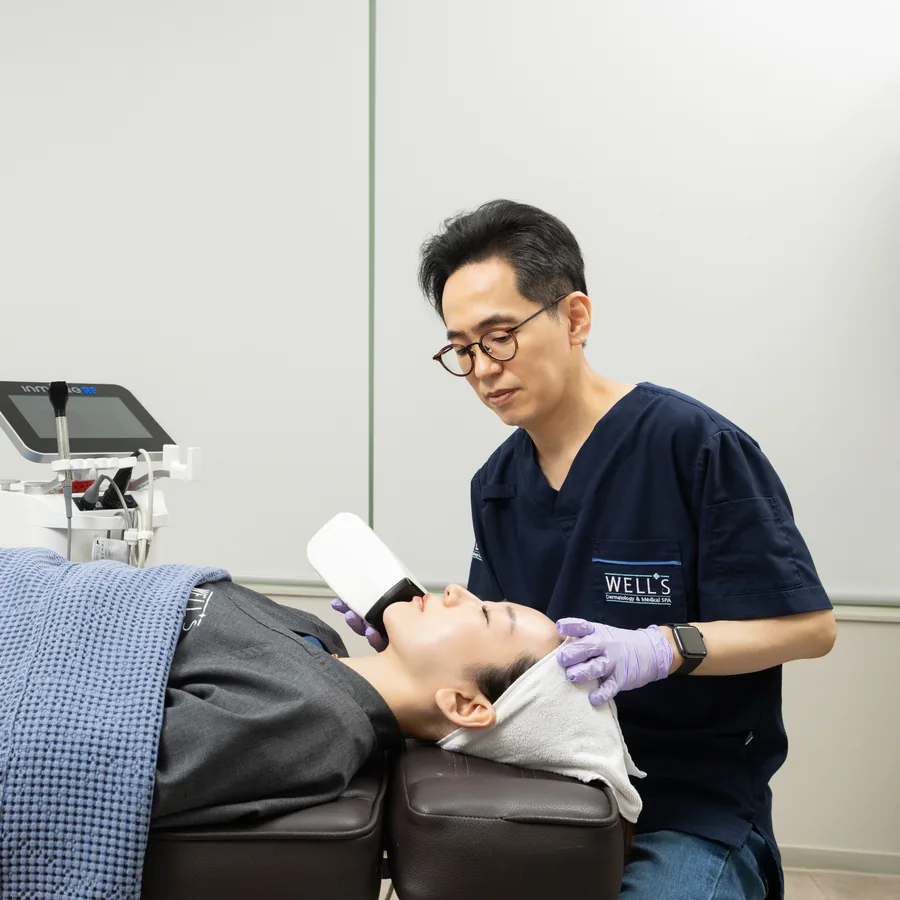
Thermage FLX is a monopolar radiofrequency (RF) device. It heats the dermis so existing collagen contracts and new collagen is stimulated over the following weeks. The expected, temporary reactions come straight from that heat.
- Warmth and redness right after treatment, which generally fade within hours to a few days
- Mild swelling, which for many people settles naturally within a few days
- Tenderness when you touch the treated area
- A feeling of tightness, which is the heat doing its job rather than a problem
These reactions are expected and temporary for most people, and they rarely stop you from walking around Seoul the same day. The dermatologist tells you at consultation what to expect for your skin specifically.
Bad Thermage side effects: what can go wrong, and why
The bad Thermage side effects people search for are real, even if they aren't what most people experience. Generally, they trace back to three things: how much energy is delivered, where it goes, and the equipment it goes through.
Burns and blisters
RF heat that concentrates too much in one spot can burn the skin. One known cause is a refurbished or non-genuine tip, which can deliver energy unevenly, risking burns or no effect at all.
A hollow or uneven look
Where the fat layer is already thin, excessive heat can leave an area looking hollow or uneven. That's why thin areas need to be identified before treatment, not discovered afterwards.
Tenderness, altered sensation or bumps that linger
Some people notice tenderness, a patch of altered sensation or small bumps that last longer than a few days. In general these settle with time, but they're a reason to message the clinic rather than wait and wonder.
Every procedure can carry side effects, and they vary from person to person. That's why at WELLS the decision always follows a dermatologist consultation, not a price list.
Who should not have Thermage, or should wait?
This is where a consultation earns its keep. Thermage suits loose skin on the cheeks, jawline and neck, fine lines and loss of firmness, but not every face and not every moment.
- A very thin face with little fat to spare: I'd rather discuss a different plan than risk hollowing
- Irritated, infected or broken skin in the treatment area: generally a reason to wait
- Implanted electronic devices such as a pacemaker: monopolar RF is generally avoided, so tell us before anything is planned
- Pregnancy: most dermatologists would postpone elective energy treatments
For comfort we use Air NOX, and it has its own limits. As our Air NOX page explains, it is not suitable in early pregnancy, respiratory conditions, panic disorder or vitamin B12 deficiency. If any of those apply to you, say so on WhatsApp and we plan around it.
How we lower the risk of Thermage side effects at WELLS
Nothing removes risk completely, and I won't pretend otherwise. What we can do is control the variables that are known to matter.
- A board-certified dermatologist handles your consultation, diagnosis and treatment
- Only genuine Thermage tips are used; if a tip is ever found not to be genuine, we refund ten times the treatment price
- No deep sedation: Air NOX (oxygen plus nitrous oxide) with local anesthetic keeps you awake
- Diagnose first: 3D skin analysis before lifting, and a skin-microbiome test before Thermage MAX
Being awake is a safety feature, not just a comfort one. Under deep sedation you can't give feedback while the heat is delivered, and you can't check the tip or the shot count yourself. Awake, you're part of the safety check.
Our Thermage MAX protocol adds another layer. Before the RF starts we infuse two bottles of AQ MAX (alanyl-glutamine), which in lab tests protected collagen-producing fibroblasts under 43–55 °C heat, the temperature range Thermage reaches.
During treatment, a collagen-peptide serum adjusts the skin's electrical conductivity to reduce the sting. Your Thermage plan is then set by the dermatologist for your face, including whether 600 or 900 shots fits the area.
What to ask any clinic before Thermage in Korea
Whether you book with us or elsewhere, these questions are worth asking any clinic offering Thermage in Korea. The answers tell you more than any price list.
- Who performs the treatment: a dermatologist, or someone else?
- Will I see the tip opened, and can I verify it afterwards?
- Will I be sedated, and if so, how will you judge the heat without my feedback?
- How will you decide the shot count, and where the energy goes on my face?
- Who do I contact if something feels wrong after I fly home?
At WELLS the tip is opened in front of you, and afterwards you receive a certificate with an authentication number and a QR code you can check on the official site. Consultations are available in English, and replies on WhatsApp are in English too.
Send a photo of your face and your travel dates. A dermatologist will tell you whether Thermage makes sense for you, and what to expect afterwards.
Ask about Thermage safetyAftercare: the first days after Thermage
Aftercare after Thermage is simple, which is part of its appeal. You leave with the dermatologist's aftercare instructions, and you can reach us on WhatsApp afterwards.
- Wear sunscreen every day, one of the simplest ways to protect the result
- Keep your skin well hydrated
- Expect warmth or mild swelling to settle within a few days
- Message the clinic about anything that feels more than mild, or lasts longer than you were told
On timing, our Collagen Booster Thermage FLX page states that results may begin to appear after about two weeks and last six to fourteen months. Individual results vary.
If you're flying home soon after treatment, tell us your flight dates on WhatsApp. The dermatologist will advise on timing.
Thermage cost in Seoul, and why the cheapest quote is a risk
Cost and safety are more connected than they look. Thermage MAX at WELLS is listed at ₩3,465,000 (VAT excluded) for 600 shots and ₩4,477,000 (VAT excluded) for 900 shots, and the dermatologist confirms your plan and final price at consultation.

A much lower quote can mean fewer shots, a different tip or a different person holding the handpiece, and the tip is exactly where bad side effects begin. For the full breakdown of shots and inclusions, see our Thermage cost guide, and for how the treatment works and who it suits, read Thermage explained.
If you're weighing Ulthera vs Thermage, the risks differ because the energy and depth differ. Ultherapy works deeper, at the SMAS layer, and our Ultherapy Prime FIT is planned with the same rules: dermatologist, genuine tips, no deep sedation.
Not sure whether you need 600 or 900 shots, or Thermage at all? Send a photo and your dates and we'll reply with a plan and the price.
Send a photo, get a planAsk a dermatologist before you book Thermage
Send your concern, a photo and your travel dates on WhatsApp. You'll get a reply in English on whether Thermage suits your skin, what to expect afterwards and available appointment times. Individual results vary and side effects are possible — every treatment starts with a dermatologist consultation.
Message the clinic on WhatsAppReplies on WhatsApp · prices in KRW, excluding 10% VATBefore you message us
What are the most common Thermage side effects?
Warmth, redness, mild swelling and tenderness in the treated area. For many people they settle within a few days. The dermatologist explains what to expect for your skin at consultation.
Can Thermage burn the skin?
Any heat-based device can, which is why the tip, the energy and the person holding the handpiece matter. Non-genuine or refurbished tips can deliver energy unevenly. WELLS uses only genuine tips, opened in front of you, with a ten-times refund if one is ever found not to be genuine.
Do I need to be sedated for Thermage?
No. WELLS does not use deep sedation for Thermage. Non-sedation Air NOX with local anesthetic keeps you awake, and no fasting is needed.
Can Thermage make my face look hollow?
Excessive heat on areas with little fat can leave a hollow or uneven look. That's why thin areas are identified before treatment, and why a very thin face may be better suited to a different plan.
How soon can I fly home after Thermage?
Tell us your flight dates on WhatsApp and the dermatologist will advise on timing.
Results and recovery vary by individual. Every treatment carries possible side effects, which are explained at the consultation. Prices are in Korean won, excluding 10% VAT, and confirmed at your consultation. This article is general information from the clinic, not a diagnosis.
Dr. Won Woo Choi
- Board-certified dermatologist in Korea; trained at Seoul National University Hospital
- Dermatology residency, Seoul National University Hospital; board certification in dermatology in Korea
- Ph.D. in Dermatology, Seoul National University
- Former clinical instructor, Seoul National University Hospital
- Adjunct professor, Department of Dermatology, Seoul National University Hospital