
Under eye filler migration: what it looks like and how it's assessed
A puffy ridge or bluish tint under the eye months after filler? A dermatologist explains under eye filler migration and how it is assessed.


Under eye filler migration: what are you seeing in the mirror?
Hello, I'm Dr. Won Woo Choi, a board-certified dermatologist and chief director at WELLS Clinic in Apgujeong, Seoul. I trained at Seoul National University Hospital, hold a doctorate in dermatology from Seoul National University, and am an adjunct professor in its Department of Dermatology. Patients often ask me about under eye filler migration, usually after noticing that filler placed months ago no longer sits the way it did.
The short answer: under eye filler migration is filler that ends up, or appears to end up, outside the groove it was meant to fill. It shows as a puffy ridge, a bulge when you smile or a bluish tint. It is usually driven by amount, depth and how much the area moves, and the first step is an in-person examination, not more filler.
Below I explain what it looks like, why the under-eye is so prone to it, how a dermatologist assesses it, and how the options generally compare.
What does under eye filler migration look like?
Under-eye skin is the thinnest and most mobile skin on the face. That makes it unforgiving: a change that would disappear in the cheek can be obvious just below the lower lid.
- A ridge or sausage-like fullness that sits above or below the hollow rather than inside it.
- A bulge that appears when you smile and flattens again at rest.
- A bluish or grey tint under thin skin, known as the Tyndall effect.
- Lumps or uneven texture where filler has gathered instead of spreading smoothly.
- Puffiness that seems to change through the day, which some people notice more in the morning.
Not every one of these is true migration. Sometimes the filler has stayed exactly where it was placed, but there was a little too much, or it was placed too close to the surface. For you the result looks similar; for the dermatologist the difference changes the plan.
Is it filler, a bag, or something else?
Under-eye fat that pushes forward can look a lot like misplaced filler, and the two often sit together. Small white bumps are a separate question. People ask me how to get rid of milia under eyes while worrying about filler, but tiny bumps are usually milia or syringoma rather than filler, and they need a different treatment.
Why does filler move under the eyes?
In thick areas such as the cheeks or forehead, a little extra volume blends in. Under the eye, a very small difference in amount can change the whole impression. Most of the problems I see come back to a handful of causes.
- Amount: more filler than the hollow can hold has nowhere to go but outward.
- Depth: filler placed too superficially in thin skin is more likely to show, clump or bulge.
- Movement: blinking and smiling work on this area all day, and filler can gather unevenly instead of spreading.
- Layering over time: repeated top-ups on top of filler that has not fully gone can build up a ridge.
- The wrong problem: filler placed over a fat bag, rather than into a true hollow, tends to make the area look heavier.
How a dermatologist assesses under eye filler migration
I look at the under-eye at rest, while you smile and look up, and in good light from more than one angle. I assess skin thickness and elasticity, how deep the original hollow is, where the vessels run, how much under-eye fat there is, and how the area fits with the rest of the face.
History matters just as much. When was the filler placed, how many times, and do you know the product? Photos from before the first treatment help me separate what was there originally from what the filler has added.
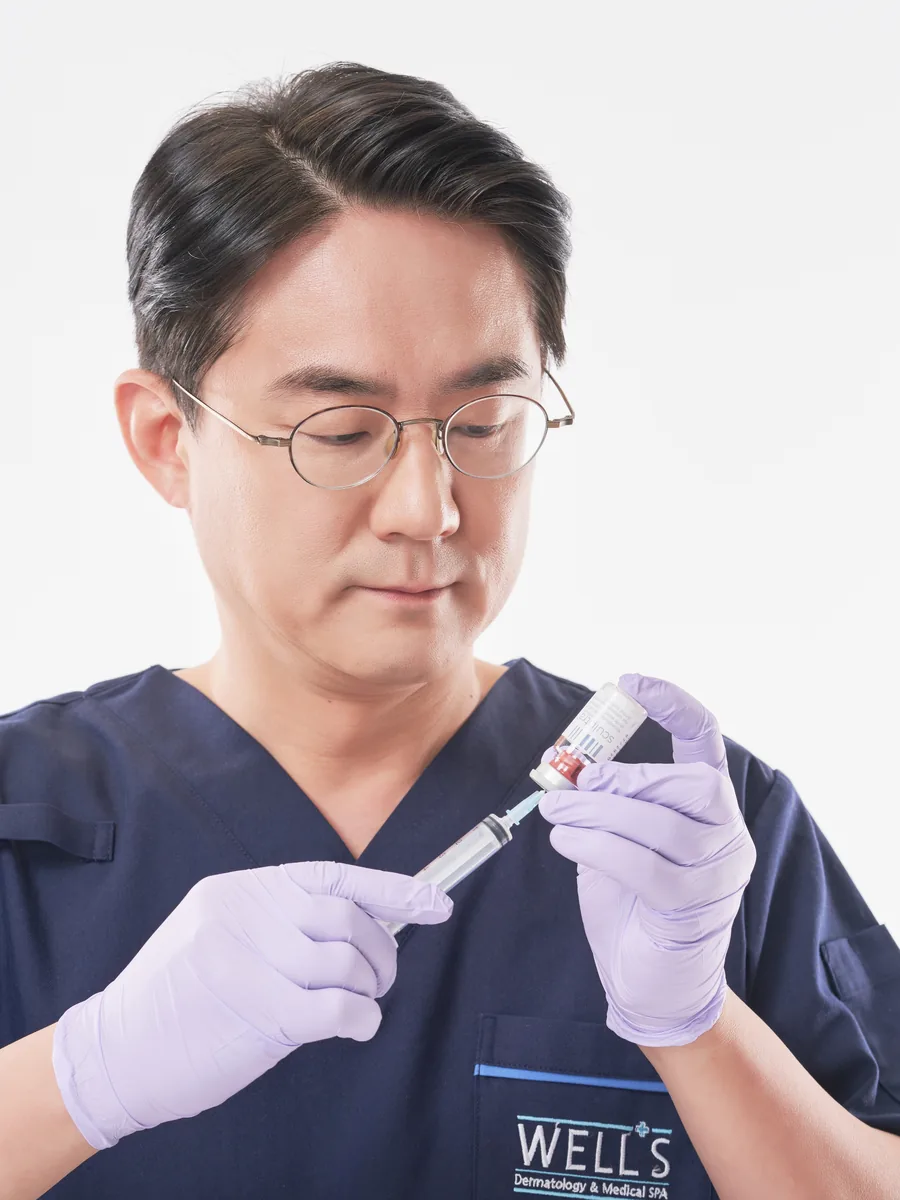
At WELLS a board-certified dermatologist handles your consultation, diagnosis and treatment. If you are planning a visit from abroad, you can start by sending photos so we can tell you what we would want to examine.
Send a straight-on photo of your under-eye in daylight, one while smiling, and the date of your last filler. A dermatologist will tell you how we would assess it.
Send photos, get an assessment planWhat can be done about migrated under-eye filler?
The answer depends on what the examination shows. In general, hyaluronic acid filler can be broken down with an enzyme, which is one reason many dermatologists prefer it for delicate areas. Whether dissolving, waiting or a small correction is right for you is a judgement for the dermatologist in front of you.
One rule I hold firmly: adding more filler on top of migrated filler is rarely the fix. It hides the ridge for a while and usually makes the area heavier.
Once the area has settled, some people still have a genuine hollow. That can be treated again, conservatively. For skin that is thin and crepey rather than hollow, Rejuran HB+ works on the skin itself: its salmon-derived polynucleotide improves the skin's internal environment, and the added hyaluronic acid strengthens hydration. Four sessions at 2–3 week intervals are recommended.
| Option | How it works | What to weigh |
|---|---|---|
| Hyaluronic acid filler | Adds volume straight away | Thin skin can show it, and too much can clump or bulge |
| Fat grafting | Moves your own fat into the hollow | Graft survival is hard to predict |
| Sculptra (PLLA) | Stimulates your own collagen gradually | Rare palpable nodules in very thin skin |
| Rejuran HB+ | Improves thin, dry skin over several sessions | Works on skin quality more than volume |
Fat grafting under eyes, fat repositioning or filler: what else is there?
After a bad experience, many people look at fat grafting under eyes instead. Under eye fat grafting can be an alternative, but its graft survival rate is hard to predict, which makes the final result harder to control in such a small area.
Under eye fat repositioning is a surgical eyelid procedure, so it belongs with a surgeon rather than an injector. It is mainly a conversation for prominent fat bags, not for a hollow. The best under eye bag treatment depends on whether you actually have a bag, a hollow, or both.
Searches for under-eye injection before and after usually come from people hoping neuromodulator will smooth the area. Neuromodulator relaxes muscle; it does not move or remove filler. At WELLS we use neuromodulator with US FDA approval only, and the dermatologist decides whether it has any role around your eyes.
How I inject the under-eye at WELLS to keep filler in place
Our dermal filler page lists the under-eye as one of five areas we treat, and under-eye hollows are treated with filler instead of surgery. Every injection is placed by a board-certified dermatologist, and we use a cannula where possible, because it minimizes the vessel-damage risk of a standard needle.
We confirm the product and the amount with you before treatment. Under the eye I would rather you leave slightly under-corrected than overfilled; the aim is a result you notice slowly, not one that changes your face overnight. My colleague explains how faces end up looking puffy in why faces look overfilled.
If you are still deciding whether under-eye filler suits you at all, my guide to Korean under eye filler covers who it suits and how to plan it. Every injectable we offer is listed on the fillers, anti-wrinkle injection and skin boosters page.

For filler, the price is confirmed at your consultation. Prices at WELLS are in Korean won and exclude 10% VAT. Answers on booking, English consultations and hours are on our FAQ for international patients, and you can read about each of us on the doctors page.
Tell us what was injected, when, and your dates in Seoul. We will suggest how to approach the assessment before you fly.
Ask about my under-eyeWorried your under-eye filler has moved?
Send photos at rest and smiling, what was injected and when, and your travel dates. A board-certified dermatologist will explain how we would assess it and what to expect at the consultation.
Message the clinic on WhatsAppReplies on WhatsApp · prices in KRW, excluding 10% VATBefore you message us
Can under eye filler migrate months after treatment?
Changes can appear months later in some people, often because filler has lasted longer than expected or extra top-ups have built up. A dermatologist needs to examine the area to tell migration from a bag or overfilling.
Can migrated under-eye filler be dissolved?
In general, hyaluronic acid filler can be broken down with an enzyme. Whether that is the right step for you is decided by the dermatologist after examining the area.
Should I add more filler to even out the ridge?
Usually not. Adding filler on top of filler that has moved tends to make the under-eye heavier. The cause needs to be identified first.
Is fat grafting under eyes safer than filler?
It is a different trade-off. Fat grafting uses your own tissue, but graft survival is hard to predict, which makes results in a small, thin area harder to control.
How much does correcting under-eye filler cost at WELLS?
For filler, the price is confirmed at your consultation, once the dermatologist has examined the area. Prices are in Korean won and exclude 10% VAT.
Results and recovery vary by individual. Every treatment carries possible side effects, which are explained at the consultation. Prices are in Korean won, excluding 10% VAT, and confirmed at your consultation. This article is general information from the clinic, not a diagnosis.
Dr. Won Woo Choi
- Board-certified dermatologist in Korea; trained at Seoul National University Hospital
- Dermatology residency, Seoul National University Hospital; board certification in dermatology in Korea
- Ph.D. in Dermatology, Seoul National University
- Former clinical instructor, Seoul National University Hospital
- Adjunct professor, Department of Dermatology, Seoul National University Hospital