
Acne treatment in Seoul: what works, and in what order
Why acne keeps coming back, what we actually treat at WELLS, and how acne scars are handled layer by layer — written by a board-certified dermatologist in Apgujeong.

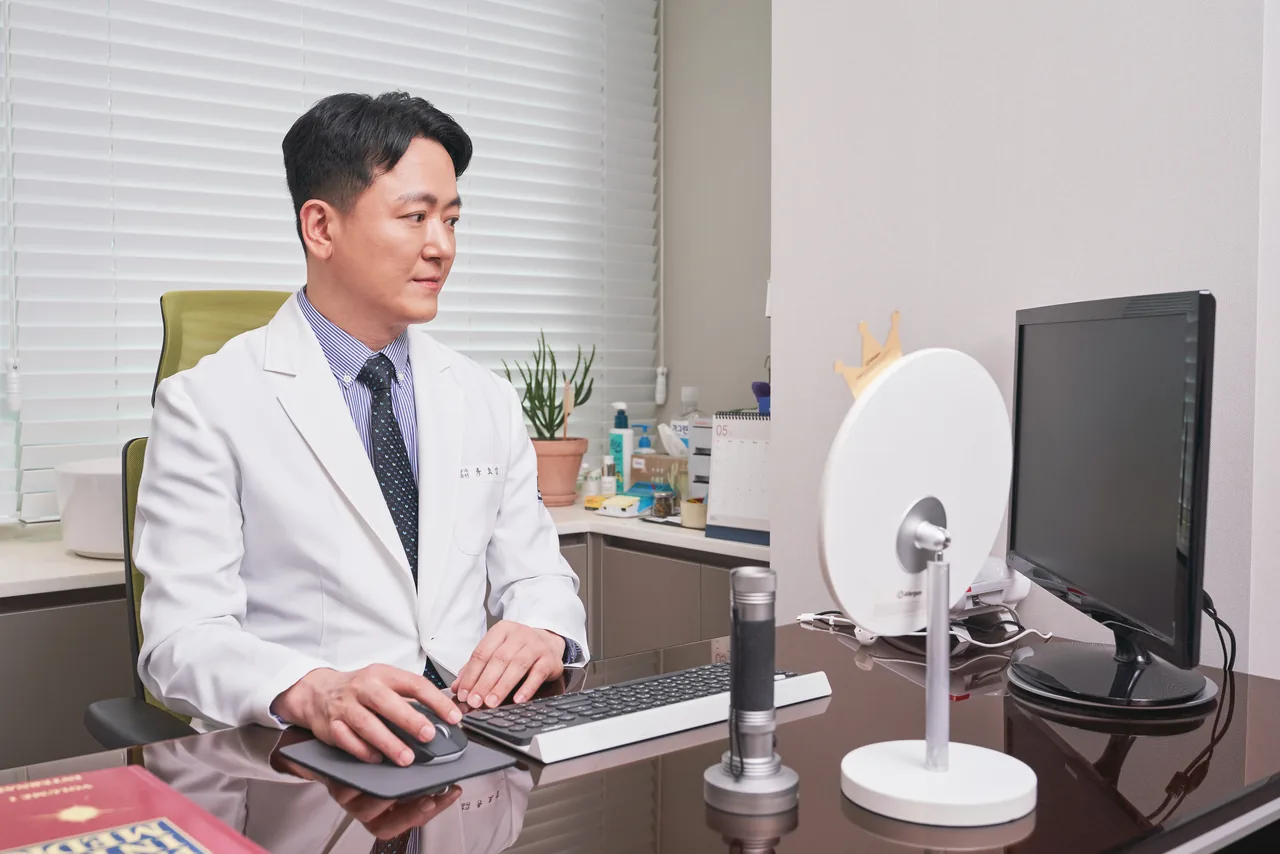
Why does acne keep coming back after creams, pills and facials?
Most people who walk into my consultation room for acne treatment have already tried a lot: topical creams, a course of antibiotics, extraction facials, maybe a laser or two. The breakout calms down, and a few weeks later it is back in the same place. That pattern is frustrating, and it is also the most useful clue we have.
The reason is simple. Those approaches treat the surface, not the sebaceous gland underneath. Acne develops in a sequence — sebum production rises, keratin thickens at the pore opening and blocks it, trapped sebum builds up, bacteria multiply, and inflammation follows.
I'm Dr. Hyo Seop Ryu, one of the chief directors here at WELLS in Apgujeong. My clinical background is in dermatology at Seoul National University Bundang Hospital, and acne is one of the conditions I see every single week. Below is how I think about it, in the order I would explain it to a patient sitting in front of me.
Is adult acne different from teenage acne?
Yes, and the difference starts with where it appears. Teenage acne usually begins on the forehead and T-zone and drifts down to the cheeks and lower face over time.
Adult acne behaves differently. It tends to settle around the jaw and the mouth, and it recurs in the same spot for months or years — healing, then returning, then healing again.
Why more adults are getting it
Several things stack up. Diets have shifted toward higher-fat, higher-calorie food. Long working days often mean heavy, pore-blocking makeup worn for ten or twelve hours.
Then there is stress. Stress triggers adrenocortical hormones that stimulate the sebaceous glands; sebum rises, pores block, bacteria take hold, and the cycle starts again.
Here is the reassuring part. Acne is not a lifelong sentence — as sebum production naturally declines with age, it eases. The real question is how much scarring you carry out the other side.
What does acne treatment at WELLS actually involve?
Our personalized acne treatment is built around the type of acne you have, not a fixed menu. Gold PTT, Blue PDT, 1450 nm acne toning and chemical peels are the main tools, and the dermatologist chooses between them at consultation.
Gold PTT — treating the sebaceous gland itself
Gold PTT stands for photothermal therapy. A gold nanoparticle ampoule is applied so the particles travel into the pore down to the sebaceous gland, then a laser of a specific wavelength is applied to the skin.
The particles absorb that light and convert it into heat, so the sebaceous gland is destroyed selectively rather than the whole surface being heated. Think of it as placing a small heat source inside the problem room and switching it on from outside.
It runs as three straightforward steps, weekly for 3–5 sessions, with little disruption to daily life. Not every Gold PTT is identical either — the shape of the gold particle (elongated rod versus spherical) changes how well near-infrared light is absorbed and converted to heat, which is worth asking any clinic about.
Blue PDT, acne toning and peels
- Blue PDT uses no photosensitizer, so there is no post-treatment pigmentation and you can go outside straight afterwards — useful if you are sightseeing in Seoul the same day.
- Acne toning at 1450 nm heats the sebaceous gland with almost no pain; we have ten years of clinical data with this laser.
- Aladdin and FCR peels exfoliate dead skin cells and stimulate collagen, and they also work on back and chest acne.
Send a photo of your skin and tell me how long the breakouts have been recurring. I'll tell you which of these is the sensible starting point.
Send a photo, get an acne planHow should I manage acne between clinic visits?
This is the part patients underestimate. Acne treatment is not one appointment — it is adjusting the intensity of care to what your skin is doing that month.
In relatively stable periods, correct cleansing and topical medication are genuinely enough to keep things controlled. You do not need a laser every week.
Flare periods are different. Around menstruation, during heavy stress, or after a stretch of poor sleep, acne can worsen — that is when oral medication, laser treatment and in-clinic care earn their place.
Escalate when it flares, step back down when it settles, and repeat. Patients who keep that rhythm reach the point where acne fades naturally with far fewer scars than those who ignore it and then panic.
If you genuinely cannot get to a clinic, most early acne can still be managed by disinfecting properly, extracting correctly, and applying your medication. What I would not do is squeeze inflamed lesions with unwashed hands at midnight.
What is Korean acne scar treatment, and why is depth the deciding factor?
When people ask about Korean acne scar treatment they usually have one product in mind — a booster, a filler, a laser they saw online. The honest answer is that no single item treats every acne scar.
An acne scar is defined by its shape and its depth. Broadly there are three kinds: icepick scars, which are narrow and awl-shaped; boxcar scars, with square indented borders; and rolling scars, with soft, undulating edges.
Why one product is not enough
Rejuran contains growth and moisturizing factors and can calm early acne, but it has clear limits on a scar that is already established. Juvelook stimulates collagen in the dermis, yet the dermis alone cannot fill a deeply depressed scar.
So we work layer by layer instead. Match the treatment to the depth of the scar, not to the product name.
| Scar stage or layer | What we use | Why |
|---|---|---|
| Early red marks | Vascular lasers such as Synergy or Clarity | Redness improves quickly when the vessel is targeted |
| Pigmented marks | Laser toning, applied cautiously | Misapplied toning can trigger new acne |
| Deep late scars | Fractional resurfacing laser, or Genius RF microneedling | Remodels collagen in the dermis |
| Dermal volume loss | Juvelook, collagen boosters or filler | Fills the deficit the dermis cannot rebuild alone |
| Deepest layer, fat loss | Sculptra added to the plan | More volume, so deep scars can also be corrected |
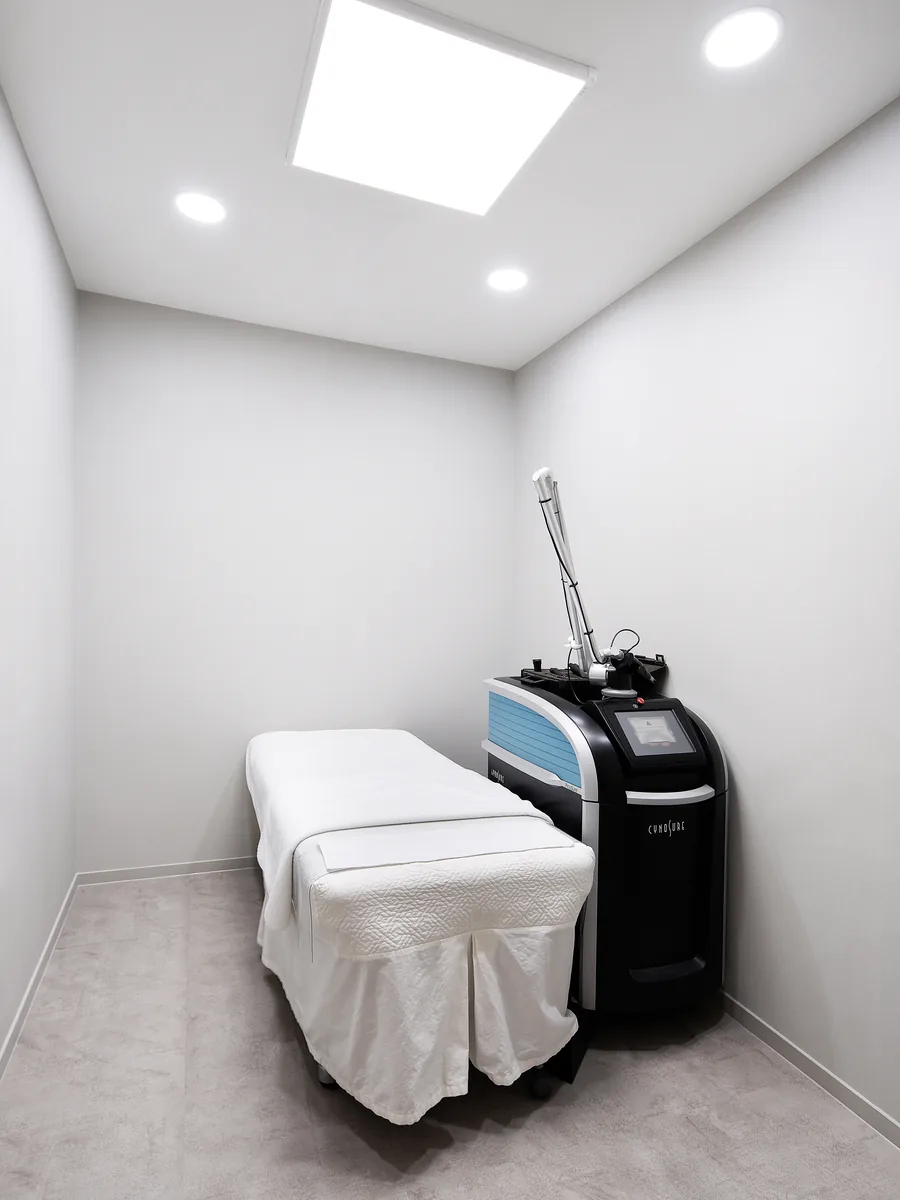
On the device side, our acne scar and enlarged pore treatment uses Fractional Picosecond Laser Treatment, which creates optical breakdown inside the dermis with almost no heat damage to the surface. There is no oozing and no artificial skin dressing, and redness usually clears in 3–4 days — which matters if you have a flight booked.
Juvelook (PLA plus hyaluronic acid, KFDA-approved) fills depressed scars immediately while stimulating collagen. Mosaic fractional laser, microneedle RF, Aquapeel and the Clarity dual laser are added depending on scar type, and we show you the result with a dermatoscope rather than asking you to take our word for it.
What about pores and redness left behind?
Two things commonly outlast the acne itself: enlarged pores and lingering facial redness. Both are treated separately from the acne, and both are worth raising at consultation.
For pores, pore reduction with Fractional Picosecond Laser Treatment changes the structure of the dermis so pores tighten from underneath, rather than resurfacing the top. Because the epidermis is spared, it suits skin that reacts badly to heat. Genius RF and Winergy are added where the nose or cheeks need extra tightening.
For redness, flushing and visible capillaries are vascular conditions, not surface stains. Our rosacea and broken capillary treatment uses Synergy, Clarity and BBL so the right wavelength reaches the enlarged vessel while normal tissue is left alone.
I'd add one caution here. Laser toning on pigmented acne marks can provoke new acne if it is applied without judgement — that is a case where who holds the handpiece matters more than which device it is.
Planning acne treatment as a visitor to Seoul
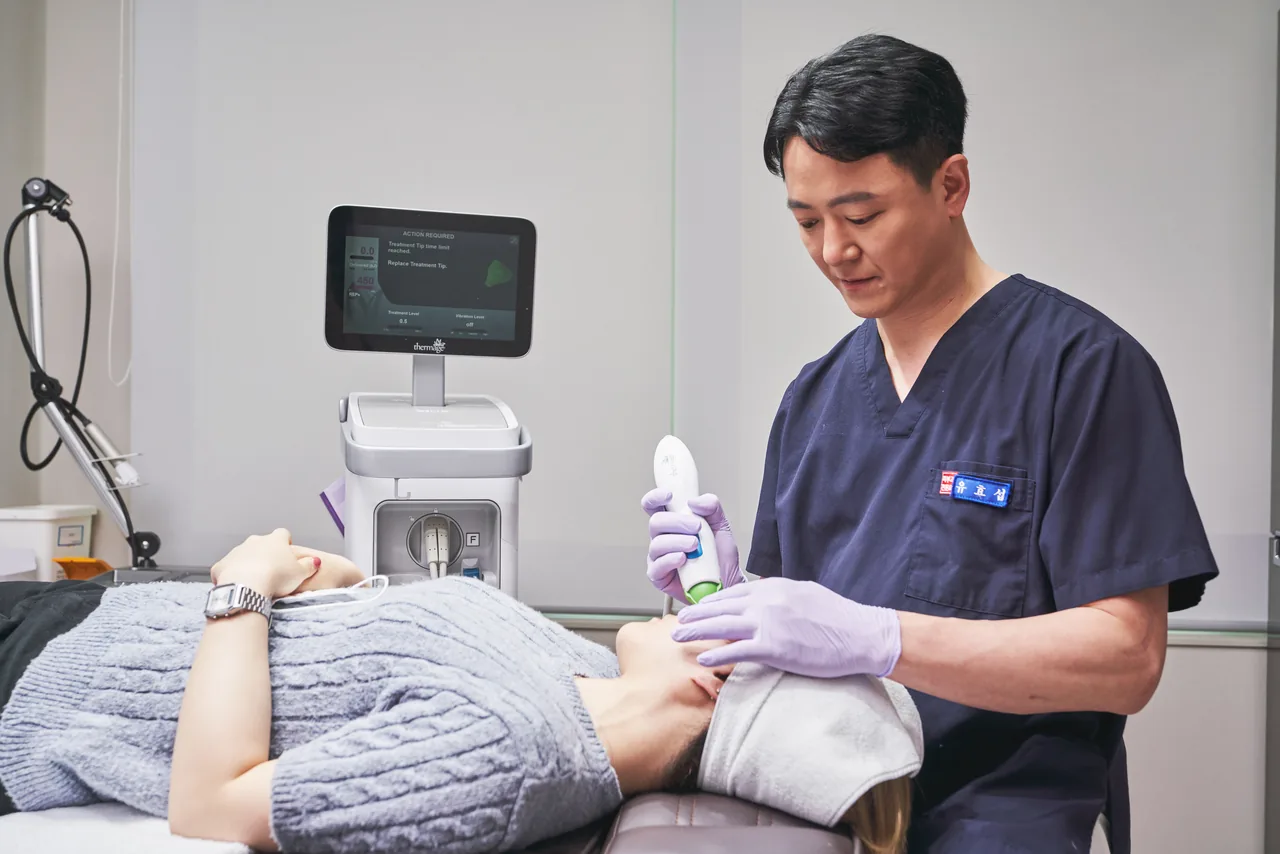
If you are flying in, timing is the thing to get right. Gold PTT runs weekly across 3–5 sessions, so a single short trip will not complete a full course — but we can start the course, treat the inflammation, and set you up with a plan you continue at home.
Scar work is different. A fractional picosecond session leaves redness that usually clears in 3–4 days, so I'd rather you book it early in the trip than the morning of your flight.
We are on the 8th floor of Apgujeong Building, 842 Nonhyeon-ro, Gangnam-gu — about five minutes on foot from Apgujeong Station Exit 3 on Line 3. Hours are Monday to Friday 10:00–20:00 and Saturday 10:00–17:00, with lunch from 13:00 to 14:00, closed Sundays and Korean public holidays. Consultations are available in English.
Prices for acne and scar treatments are confirmed at your consultation, because the plan depends on what your skin is doing on the day. You can see the full range on the acne, scar and pore treatment hub, and if you want to read specifically about depressed scars, our post on atrophic scar treatment in Seoul goes deeper.
Tell me your travel dates and what bothers you most — active breakouts, scars, or both. I'll map out what fits into the days you have.
Message the clinic with your datesSend a photo, get an honest plan
Acne and acne scars are easier to plan when I can see them. Message us on WhatsApp with a clear photo, how long it has been going on, and your dates in Seoul — you will get treatment options and appointment times in English before you travel.
Message the clinic on WhatsAppReplies on WhatsApp · prices in KRW, excluding 10% VATBefore you message us
Why does my acne keep coming back after antibiotics and creams?
Because those treat the surface rather than the sebaceous gland, which is the root cause. Acne forms when sebum rises, keratin blocks the pore, sebum accumulates and bacteria multiply. Treatments that only calm the current breakout tend to be followed by recurrence.
Where does adult acne usually appear?
Adult acne characteristically appears around the jaw and mouth and returns to the same spot over long periods. Teenage acne more often starts on the forehead and T-zone before moving down to the cheeks and lower face.
How many Gold PTT sessions will I need?
Gold PTT at WELLS is done weekly for 3–5 sessions, with little disruption to daily life. The dermatologist confirms the number and whether Gold PTT is the right choice for your acne type at consultation.
Can Rejuran or Juvelook alone fix my acne scars?
No. Rejuran can calm early acne but has limits on established scars, and Juvelook works in the dermis, so it cannot sufficiently fill a deeply depressed scar on its own. Scars are treated according to depth, often with a combination.
How much does acne treatment cost at WELLS?
Price for acne and acne scar treatment is confirmed at your consultation, once the dermatologist has seen your skin and set the plan. All prices are in Korean won and exclude 10% VAT.
Will I have downtime after acne scar treatment?
With Fractional Picosecond Laser Treatment there is no oozing and no artificial skin dressing, and redness usually clears in 3–4 days. Tell us your flight dates on WhatsApp and we will schedule accordingly.
Results and recovery vary by individual. Every treatment carries possible side effects, which are explained at the consultation. Prices are in Korean won, excluding 10% VAT, and confirmed at your consultation. This article is general information from the clinic, not a diagnosis.
Dr. Hyo Seop Ryu
- Board-certified dermatologist, M.D., Ph.D.
- Clinical instructor, Department of Dermatology, Seoul National University Bundang Hospital
- Assistant professor, Seoul National University Bundang Hospital
- Visiting professor, Dubai Maris Clinic, through International St. Mary's Hospital
- Former chief director, Bundang Bon Dermatology Clinic